
Breastfeeding a child in questions and answers

Answers to frequently asked questions by women.
If my child has just been born, when to start breast-feeding?
Since the birth of your child, he is always with you. First contact your child takes place in the delivery room. Once your child is born, midwife immediately put it to you on the belly, He puts on his hat, socks and covers you both blanket to keep warm.
About half an hour after birth (it can be earlier or later) the child begins to move and crawl to the breast. This is a sign, that he is ready to begin to breastfeed. And then it will be the first experience of breastfeeding. First, the midwife will help you put the baby to breast, and then you and your child will be able to cope, and then you create a great team, that breastfeeding will give pleasure and joy.
You will be with your loved one in the delivery room for about two hours, then you will be transferred to the postpartum unit.
Why breastfeeding? Is artificial milk is not good?
Mother's milk is evolutionarily formed millions of years, so it is perfect for kids. It is never too strong or very weak, it contains all nutrients, baby needed in the first 6 months of life. Breast milk is clean and safe. It is always the right temperature and can not get dirty. Breastfeeding helps you lose more excess body weight after giving birth. Artificial milk made from milk, which is only suitable for calves! Artificial milk does not protect your baby from infection, stomach upset, colds and many childhood diseases. Also, artificial milk contains many minerals, vitamins and other components for the harmonious development of your child.
Artificial feeding is expensive: You will have to buy a bottle, Nipples, artificial milk or formula and sterilize all this before each use.
It is necessary to prepare the breast for feeding my baby?
No. Preparing your breasts during pregnancy has no effect on breast-feeding your baby. Furthermore, breast massage and stretching the nipples during pregnancy can cause injury, and increase the threat of premature birth. When you are pregnant, your breasts are getting ready to produce milk and that is why after the birth of the baby early milk – molozivo – He is already waiting in the chest. Colostrum is very important for your child, because it has a unique biological composition, promotes maturation of your child's stomach and protects it from many infections. Your baby will receive colostrum within 3-4 days. During this time, the colostrum starts to change into mature milk. When this happens, you, perhaps, Your breasts will feel hot and heavy for a few days. If a caesarean section was carried out, milk, perhaps, will appear later.
How often should I feed the baby?
Everytime – When your baby wants it.
You, probably, notice, that your baby is eating normally, and then sleeps. If you're lucky, baby can sleep 3-5 hours at night, but remember, that your baby has not yet learned to distinguish between the time. Many kids do not understand for a long time, that night – for sleep! Therefore, you have to feed your baby during the day, and night, usually every 2-3 o'clock.
First, most of the kids fed 8-10 once a day. Frequent feedings are needed first, to stimulate the breasts and establish regular milk production. Since a few weeks your milk will change, to meet the needs of an older child, intervals between feedings, perhaps, will be longer.
Babies suck the breasts are not only feeding. Your breasts – This food, beverage, love, comfort and safety for your child. If you put your baby to the breast every time, when he asks, you can not hurt him, but only make it more healthy, happy and satisfied.
It's milk, and chest were filled with so, that the child is difficult to get them! What to do?
You need to try as much as possible to put the baby to the breast in the first hours after birth, then the milk will gently.
Frequent feedings help to overcome overflow, which has already appeared. No one so well will not help Mom, her child!
To remove the swelling, which has already appeared, You can apply a cold compress to the chest (on 15-20 minutes) in the intervals between feedings. Cold reduces swelling and pain. Some moms like to use for this washed with soap and chilled cabbage leaves.
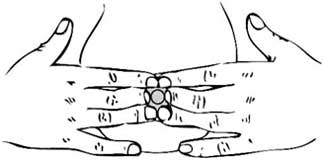
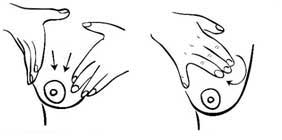
Sometimes it helps a little bit express milk, standing under the shower. Heat is better to use just before feedings, it helps the milk to flow better. This can moisten the towel with warm water, press it and attach to the breast 2-3 minutes before, how to give their child. If such a solid areola, the baby's lips slide on the nipple, you can prepare the breast for feeding, putting his fingers on the areola, around the nipple, as shown. Gently press in the direction of the chest (It should not hurt!) and hold a constant pressure 1-3 minutes.
When you remove your fingers, areola will be much more flexible, and the child will be easier to take the breast well, Besides, the milk begins to flow by itself. You can repeat the procedure, If mitigation is not enough.
You should never force a swollen breasts to knead itself or with someone's help – it can injure the delicate tissue and cause inflammation. If the child is not yet able to suckle, After softening the areola pressure using pumping equipment.
Maybe, Should I stop drinking, when it comes to milk?
You do not need to suffer from thirst! Studies have repeatedly shown, that limiting drink does not affect, how intensively the milk comes. Drink as much fluid, as you want, often Put your baby to the breast, and soon you will feel much better!
Is breastfeeding painful?
If you correctly put the baby to the breast, breastfeeding for you – Painless. However, if you properly put the baby to the breast and your nipple are damaged, then feeding becomes painful. During his stay in the hospital will provide you with comprehensive information on breastfeeding and practical help to make your baby to the breast. Ask for help!
During the first week you, perhaps, You feel discomfort for a few seconds, when the baby starts sucking, but after a while it passes. Your breasts are not used to feed the baby every few hours, but it is temporary, and then breastfeeding is for you to relish!
How should I put the baby to the breast?
First latch baby to the breast, perhaps, It will seem awkward. This is because, that your baby – learner, He has not had breastfeeding and requires a lot of practice. After a while you and your baby will be the team, and breastfeeding will be for you in the same integral process, as breathing.
There are a few common position for feeding, in which you can keep your baby, to feed him, – Experiment, to find the position, which is convenient for you both.
If the seat seems to you a very painful or uncomfortable, You can lie on your side, but most mothers say, they can cope better sitting. Remember: feed can be in any convenient position for you.
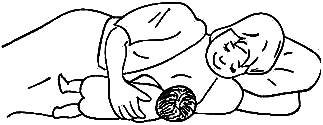
In order that the child is well latched on, when you feed her lying on her side, keep it close to you. The kid does not have to suckle on the back, turned to one side, to the chest, head – so it would be inconvenient to have the nipple and will slip out of his mouth. Tummy child must be pressed to your body (cm. arrows in Figure), and the nipple should be directed to the spout baby.
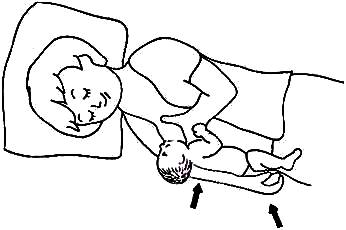
Lieber will completely lie on your side, and not hang over a child, rely on elbow. Under his head and back as many pillows, How much do you need, it is good to relax. During feeding you can just put a child or an additional hold its hand.
If I want to feed the baby sitting, what should I pay attention?
When my mother sitting feeds, baby also always be pressed to her mother tummy. Toddler need a good support, that he felt confident and well-sucking.
If the child is very small, You, perhaps, It will be more convenient to put it in the first positions, depicted hereinafter. They are easy to, to "target" file breasts. Note: no need to put pressure on the baby's head itself! Your fingers will keep the neck and the back of the baby, and his neck will be free. So the child will be convenient to reach for the nipple and wide open mouth.
You can find a toddler more comfortable position for feeding. After this practice, you will be able to feed, even moving around with a toddler at home!
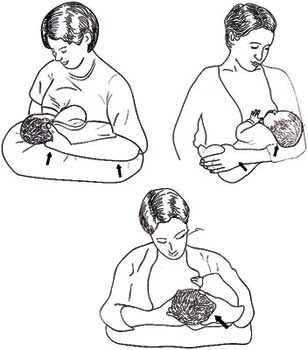
Sit upright, with a straight back, relying on the legs. Maybe, You will be convenient to put a pillow on his lap, to support your baby's hands and give support. If needed, and put a pillow under his back: feeding should be rest for mom! Do not wrap the baby in a blanket – he can not lie close enough to you and move, to find a comfortable position for yourself.
It is important to understand, that the pacifier is no milk. When your baby starts sucking, the milk begins to flow from the breast deep into the chest down to the rallying pockets, which are located under the nipple and areola, and only then – to the nipple. It is therefore important, that your baby is not only captured the mouth nipple, but much of the areola, otherwise it will not get any milk, You will be hurt. Remember, Your baby sucks not the nipple, and the breast!
Breastfeeding: step by step
Turn your baby to her so, to his head and body were in the same plane, and his nose was in front of your nipple.
You can keep your chest near the bottom arm (Left-hand – left breast and vice versa), the other hand supports the neck and shoulders of your baby. Do not support the back of his head – kids do not like it. His head will rest on your fingers.
Zoom the baby to her so, his body completely relate to your.
Touch lips nipple, to tempt him to reveal his mouth. Be patient, do not hurry – You have a lot of time!
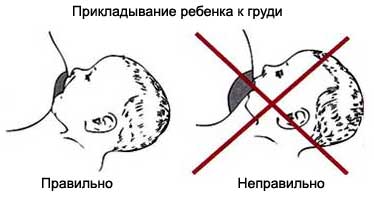
When the baby's mouth is wide open, zoom into it to your chest, aiming your nipple to him in the sky. For a child it is very important to take a deep lower part of the chest and into the mouth portion of the areola, because it was his lower jaw and tongue "extract" milk from the breast.
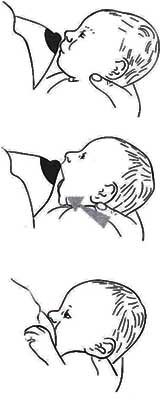
If your child's cheeks dimple formed, he sucks – This evidence, that the baby is properly attached to the breast. Subtract it from the breast and start the application again.
If feeding becomes uncomfortable for you, stop the process, with his little finger between the jaws of the child. Attach the child one more time.
Most babies first requires considerable practice and many attempts, but the experience will make breastfeeding an enjoyable and painless.
How long does it take to feed your baby?
It depends, how hungry your baby. Since the baby's appetite changes, As with adults. He can suck so much, as it needs.
Forget about the clock and watch baby. At the beginning of feeding his sucking will be very powerful, with brief pauses to swallow, but then it will change to a longer.
Suck for a while, the child will pause for rest, and then start sucking again, as soon as the ready. At the end of feeding the child will begin to quickly suck and swallow. Sated, child move away from the breast. Never tear the child from the breast alone – he knows, when to do!
It is important to allow the child to remain in the mother's breast, until he decides to stay. This ensures, he will get enough milk, especially “rear” milk – fat, very nutritious milk, which comes during the last feeding.
One or both breasts?
Keep your baby from one breast, until he decides to stay. If he makes a short break – You, perhaps, replace diapers, and then offer the other breast.
Because a small baby belly, at the beginning of it, perhaps, becomes breast fed one after. However, most kids want extra milk or other breast. Allows him to decide the matter itself.
How do I know, my baby is getting enough milk?
The kid is getting enough milk, if:
- he is hungry and worried before feeding and fed and happy – after;
- relaxed, when it is fed;
- gaining weight: All children grow up differently – some gain 120 g per week, other – 280 g and more;
- It has a mild, yellow chair;
- You change wet nappies 6-8 once a day.
Does my baby extra fluid?
No. Breast milk – it's all, that it is necessary to your child for the first 6 months of life. Even in hot weather toddlers need no additional liquid or food. They are simply more likely to feed.
What to do, if I believe, I have enough milk?
Think positively! There is no reason to reduce the amount of milk, If you feed your baby every time, when he is hungry.
When your baby is getting milk, Your breasts, respectively, forms more milk. Hence, the more often you feed your baby – the more milk is produced. Do not accumulate in the breast milk for feeding – it slows down the formation of a new milk.
For, to you and your child could enjoy breastfeeding and communication, appropriate skin-to-skin contact. Undress your baby, leave only his diaper and put it on his chest under his shirt.
So you get a perfect skin-to-skin contact. Try to do it as often as possible. This will increase the level of hormones, responsible for the production and release of milk,
It will give you confidence in breastfeeding and helps create lasting psycho-emotional contact between you and your baby.
Remember, that the growth of the child jumps come about 3 of the week, 6 weeks 3 of the month. They are growing up at this time is very fast and require frequent feeding, because they feel hungry. It can make you feel, that your milk has ended. This is not true! Follow recommendations, and all will be well again!
Should I avoid any food for breastfeeding?
It is not necessary! You can eat any food, but eat a balanced diet and moderate.
Remember! It is necessary to regularly eat during the day, because your child takes every day from you 500 – 600 calories.
You can be thirsty, When feeding baby. Drink enough water, to satisfy it.
Avoid alcohol and smoking – it could badly affect the quality of milk and the baby's health!
To increase the amount of milk needed:
- Check the position of the baby during feeding. If it does not suck the milk from your breasts – its amount for subsequent feedings will be considerably less.
- Feed often within days (at least every 2 hours during the day and at least once at night).
- Drink plenty of food.
- Relax with baby, when he rests. Do not try to be super-mom – it does not exist!
- Try to plan your daily schedule stay with the baby: sleep with him, walk around together, do odd jobs, when your baby is in your arms or in a skin-to-skin contact.
How long do I need to nurture a child?
In the first six months of life your baby does not need anything, but your milk. Only after 6 months in the diet can be introduced extra food.
Your breast milk is always better for your baby, it changes the composition according to the needs of your child is – so try to nurse his chest as long as possible.
Ideal for your baby is exclusively breastfed up 6 months, and after the introduction of additional food – continued breastfeeding up 2 years or more.
Expressing milk is a very profitable, if you are not constantly near her child, or if your baby is still quite weak to, to suck all the milk from the breast. If I need to express milk – how to store it?
Expressing your milk safe for, if you adhere to the following rules:
- Experiment, to find the best time for pumping.
- Very carefully wash your hands before you start.
- Before decanting pour over boiling water dishes, in which you express milk.
- Dishes for pumping should be a broad "throat", to avoid spilling milk.
- Utensils should be tight-fitting lid.
- Put the milk in the refrigerator immediately after pumping. If you express milk for 24 hours, add the milk to the pre Expressed.
- Milk can be stored up to 5 days at a temperature 4 ° C or lower. If it smells sour – do not use it.
- Freeze milk, if you do not use it for more than two days. Frozen milk at a temperature -18-20 ° C can be maintained for a long time (up to 3 months). If you thawed milk for breastfeeding, milk residues do not freeze again, and pour out. Do not thaw frozen milk in the microwave or oven.
- You can add fresh expressed milk to frozen.
When I have to express milk?
Typically, there are several reasons, Why do you want to express milk:
- Your child was born prematurely and can not breastfeed their own. Express milk, You can feed the baby by cup;
- the first few weeks, you will feel sometimes overflows the breast. Maybe, You and your child will be more comfortable, if before feeding You Decant a little milk – to his chest became soft;
- You have returned to work and decided not to interrupt feeding your baby breast milk.
How to express milk from the breast?
If you do not decanted before regular milk, probably, Decant the first time you are very little milk. However, this does not mean, that you have a little milk, just need more practice.
Before decanting is advisable to do a light massage the breast. This will help improve the allocation of milk. You can gently pat the breast from base to nipple or massage their light circular movements makes movements, the most pleasant for you. Massage should not cause pain.
Technique to express milk
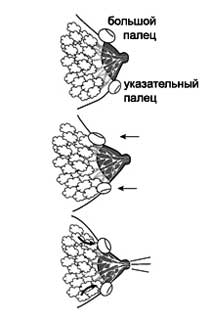
It is important to remember, that there is no milk in the nipples. Chest does not look like a dummy with the bottle. Milk only flows from the nipple, and you will not be able to express milk, clicking on the proper nipple. Milk is collected in small bags – milk sinuses, located under the areola (a brown ring around the nipple). To the touch, they look like little fasolinku.
- Place your thumb on top of your hand, and the index – below the edge of the areola. Maybe, you feel under your fingers milk sinuses ('Fasolinku).
- When you have found milk sinuses, gently push them two fingers in the direction of the chest, and then roll the fingers forward, squeezing of the breast milk sinuses.
- Remember: sinuses are located around the areola, so you should clear all the bags, sinuses, moving the thumb and index finger around the areola, removing milk from the mammary sines.
Experiment – and you will find it a convenient way for you pumping!
Expressing his hands should not cause pain. If you feel uncomfortable or pain, You can try other ways pumping. For Example, the use of electrical and mechanical breast pumps. In these situations, it would be appropriate to consult a specialist, which will help you in choosing the proper technique of pumping.
